What are common types of clinical trials that IRENE participates in?
There are two main types of clinical trials, randomized controlled trials (RCTs) and pragmatic clinical trials (PCTs). RCTs are designed to learn how well a treatment works under ideal circumstances. The downside of RCTs is that their strict inclusion criteria may limit the number of patients who can participate, and some patients might end up in a control group that does not receive the treatment.
PCTs compare treatments in real-world health system practice, so the patient continues to receive services. Most of the research projects supported by IRENE are PCTs. PCTs are important to comparative effectiveness research (CER), which compares existing health care interventions to determine what works best in routine clinical practice.
Why would a clinic or pharmacy participate in clinical research?
There are several benefits to patients and clinics or pharmacies for participating in clinical research.
Clinic or pharmacy benefits:
- Some studies offer financial incentives for participating
- Opportunity to learn or practice research skills
- Opportunity to help analyze or present research findings
Patients benefit:
- Some studies offer financial incentives for participating
- Access to additional services or support through the treatment that is being studied
- Opportunity to participate in research that could improve health care delivery
What are the different phases of clinical trials?
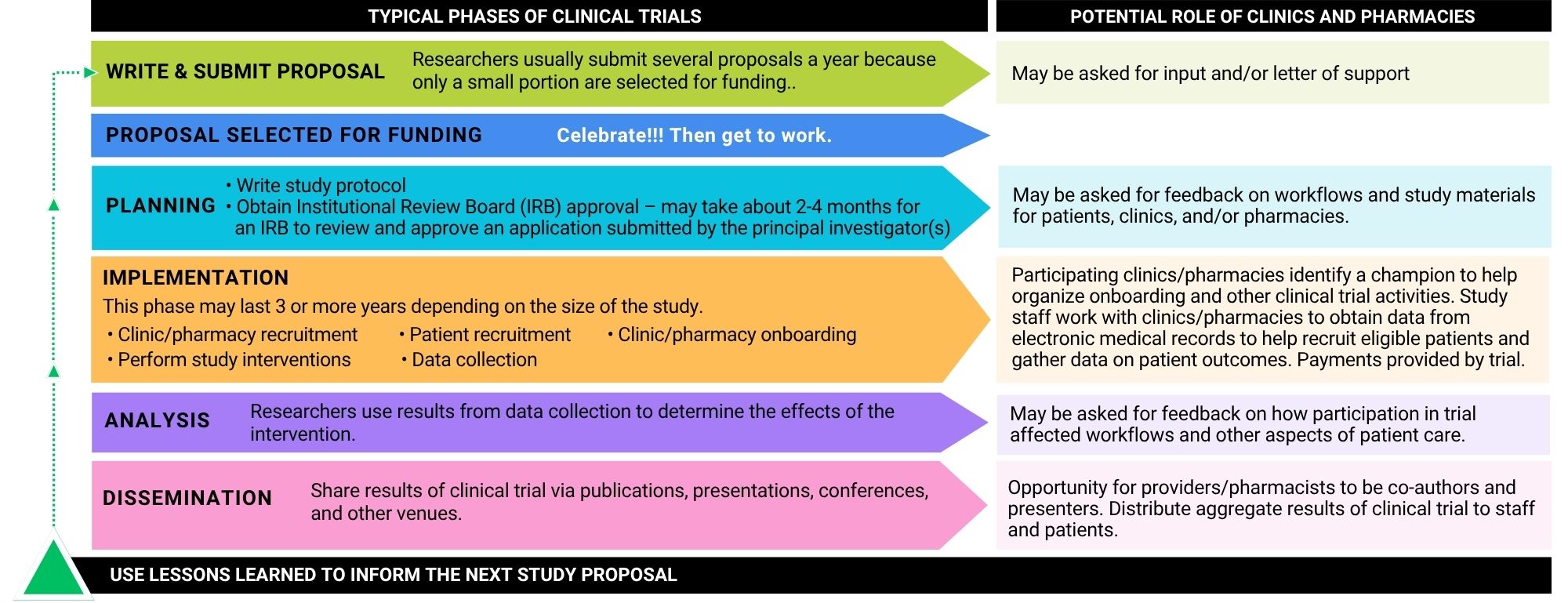
Phase: Write and submit proposal
Timeline: Proposals are often due at various times throughout the year, but it may take several months to hear back if it was selected for funding.
Description: Investigators work with clinic/pharmacy collaborators to draft a research proposal based on shared interests and requests from funders and industry sponsors. IRENE works with several funders including PCORI, NIH, and CDC.
Role of clinic/pharmacy collaborator: Investigators handle most of the technical details, but the strongest research proposals are built with your input. As a clinician or pharmacist, you see what matters most to patients and what could improve care. Your experience helps shape research questions that are practical, relevant, and ready for use in everyday practice. Your insight helps answer:
• Why is this research important for everyday care?
• What issues could it help solve for providers, pharmacists, and patients?
• How likely is it that the results would be used in real practice?
Your voice ensures research stays focused on what matters most to the people delivering and receiving care.
Phase: Proposal selected for funding
Description: This is the stage when the research team is notified if they receive funding for the project!
Role of clinic/pharmacy collaborator: Celebrate!
Phase: Planning
Timeline: This phase can take several months but is usually dictated by the project timeline set by the project funder.
Description: Once a proposal is funded, planning begins. The research team develops a study protocol—a detailed instruction manual describing:
• Objectives: What we’re trying to learn
• Design & Methods: How the study will be organized & What procedures or tools we’ll use
• Participants: Who can take part and how they’ll be identified and invited
• Data: How information will be collected, stored, and analyzed
• Safety: How we’ll monitor for and respond to any health concerns
Two key protections are:
• Informed Consent Form (ICF): Explains the study in plain language so patients can make an informed choice.
• Institutional Review Board (IRB): A committee that reviews the research plan and patient communications to protect participant rights, privacy, and safety. No study can begin until the IRB gives approval.
Role of clinic/pharmacy collaborator: Your partnership helps make sure the study fits smoothly into busy clinics and pharmacies. At this point, you will also help ensure patient safety protections align with your organization’s protocols.
Phase: Implementation
Timeline: This phase may last several years, depending on the size of the study.
Description: This is the phase when a study transitions from planning to action within clinics and/or pharmacies. Participating clinics and pharmacies receive support from study staff, including information about the study and training on any required procedures. Study staff work closely with each site to fit the study into existing workflows and reduce burden as much as possible. For example, studies often rely on information already in the electronic medical record to help identify eligible patients and track outcomes, rather than adding extra documentation. Many studies also provide financial support or incentive payments to participating clinics and pharmacies to recognize the time and effort involved. Throughout this period, study activities are carried out according to the protocol approved by the Institutional Review Board (IRB), ensuring that patient safety and privacy remain a top priority.
Role of clinic/pharmacy collaborator: If you have not already decided to participate, this is when you can make your decision. If you are participating in a study, your organization will start integrating the study activities into everyday workflows and patient care practices.
Phase: Analysis and Dissemination
Timeline: This phase sometimes happens concurrently with the implementation phase. Usually there are also a few months at the end of the project timeline dedicated to analysis and dissemination.
Description: During this phase, the team turns collected data into information that can guide day-to-day care. There are gaps in the dissemination phase that we are working on closing. Many completed clinical trials still fail to publicly report results within two years, which limits evidence-based decision-making. Participants and health care professionals value timely, concise summaries, yet projects often prioritize dissemination to researchers over patients and front-line clinicians. With IRENE, we want to make planning for dissemination to patients and health care professionals a core design requirement, not an afterthought.
Role of clinic/pharmacy collaborator: As the team is analyzing the data, there will often be questions about benefit, harm, and practical use that clinics and pharmacists can help answer. It is great when clinicians and pharmacists can co-author and present information from the study at their organizations, conferences, or through publications.
What should I ask if someone asks me to be involved in a clinical trial?
If a researcher approaches you and your organization to be part of a clinical trial, here a few helpful questions you can ask them before deciding if participation is right for you.
- What will the benefits be to the patients?
- How is the research team protecting the safety and privacy of patients?
- What will clinic or pharmacy staff members be responsible for?
- What documentation do you need from the clinic or the pharmacy?
What are the different types of involvement in clinical research with IRENE and Iowa Health Care?
IRENE and Iowa Health Care have developed several ways that clinics or pharmacies can be collaborators in research. Each category has a different capacity for the clinic or pharmacy, and different documentation requirements. It’s important to have these established up front to keep patients safe.
Category A
Clinic/Pharmacy team capacity: The clinic or pharmacy can provide space for the research team to conduct patient visits and hand out recruitment flyers to patients. The clinic or pharmacy cannot consent patients for research activities or perform any research activities.
Documentation requirements
- Partnership agreement letter from the clinic or pharmacy to Iowa Health Care
Category B
Clinic/Pharmacy team capacity: The clinic or pharmacy can provide space for the research team to conduct patient visits, hand out recruitment flyers to patients, provide patient referrals to the Iowa Health Care research team, and provide electronic medical record access to Iowa Health Care research team members. The clinic or pharmacy cannot consent patients for research activities or perform any research activities.
Documentation requirements:
- Partnership agreement letter from the clinic or pharmacy to Iowa Health Care
- Waiver of HIPAA authorization
Category C
Clinic/Pharmacy team capacity: The clinic or pharmacy can provide space for the research team to conduct patient visits, hand out recruitment flyers to patients, provide patient referrals to the Iowa Health Care research team, provide electronic medical record access to Iowa Health Care research team members, help the Iowa Health Care research team identify eligible patients for research studies, and use Iowa Health Care systems to document research data.
Documentation requirements:
- Partnership agreement letter from the clinic or pharmacy to Iowa Health Care
- Waiver of HIPAA authorization
- HIPAA training attestation from the clinic or pharmacy
- Participation in a live Human Subjects research training